The AIDS Quilt

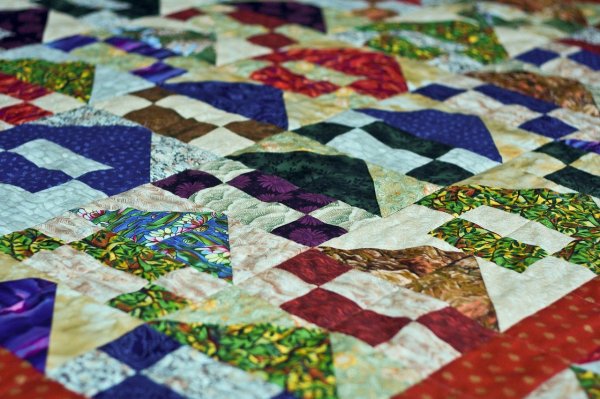
Often abbreviated to the AIDS Memorial quilt, The NAMES Project AIDS Memorial Quilt is a tribute to many who have sadly passed due to the AIDS pandemic and AIDS related causes. Immense, it is estimated to weigh over 54 tons and as of 2010, it is the largest piece of community folk art in the world.

How it All Began
AIDS activist Cleve Jones derived the idea for the quilt in 1985 and started it in San Francisco with 3 others to help. It exploded from there, and was first displayed in 1987 with less than 2,000 squares commemorating loved ones who had fallen to this terrible disease. The display was held in Washington D.C., on the National Mall, with over half a million people traveling, some who were local and many who lived great distances away, to witness it that weekend. The quilt was, at that time, larger than a football field.

The response was staggering, and the quilt went on mobile display over a four-month period, hitting 20 cities, and in each it continued to grow as local panels were added. By the end of the tour, there were 6,000 panels, tripling its size. By 1988, over 8,200 were presented to the public again in front of the White House on the Ellipse. The reading of each individual name has become a tradition somberly followed at almost every Quilt display. The Quilt would go on to more public displays in 1989, 1992 and 1993. Its final showing was in 1996, where the Quilt covered the vast entirety of the National Mall. To give you some perspective, the National Mall is 146 acres. That, unfortunately represents far too many people passing from AIDS and related illnesses.

Nominated for the Nobel Peace Prize in 1989, the Quilt has been subject of numerous books, poems, articles, essays, documentaries, and even films. Redefining the art of quilt-making, the AIDS Quilt has shaped a new attitude towards community response in modern situations and elevated the tradition to something higher.

If you have a loved one who has fallen to AIDS, then you may desire to add your panel to the AIDS Memorial Quilt. One need not know how to quilt to add a panel; any panel -painted, appliquéd, cross-stitched, or even iron-on transfer will work for commemoration. Some choose to make their panel privately and by his or her lonesome, others take a more traditional quilting route and gather the help of friends. However you best work, the important thing is to honor your loved one. Make sure to design your panel to include at minimum the name of the person remembered, but feel free to add details like date of birth and death, special talents, hometown, impacts your loved had on his or community or accomplishments that are worth making note of.

The quilt will be folded and unfolded often, so choose a material accordingly and durability is of the essence. Cotton duck or a non-stretch poplin or medium weight work best. Eschew glue as it deteriorates and instead favor sewing, painting or iron-ons. As mentioned, there is no limit placed on the artistic expression for these panels. Photos are even allowed. It is recommended to think long-term and work accordingly, in an effort to keep the panel as fresh ten years from now as it is the day you make it.

If you would like more information, the address to send panel to and what to include in the letter, please see the AIDS Quilt panel making page.

Posted in Uncategorized | Leave a comment

Quilting Superstitions and Lore

Quilts have been around for so long and have been such an integral part of people’s lives that superstition and lore surrounding them is to be expected. Some of these stories have been passed down through the years, and some are heard once in a while but seldom repeated. Either way, they are part of traditions and part of families, just like the quilts.
Superstitions
1. No matter how tempted you are, never make a perfect quilt. Always make one mistake.
a. People have said this, at least in the United States, throughout recorded history. This is in reverence and honor to the Christian God. The logic behind this is that for anyone who believes in Him, they all know that He is the only perfect being. Making a perfect quilt is an insult to His perfection
2. Sewing a quilt on Sunday is bad luck.
a. Again, this is related to Christianity. Sunday is a day of rest. No matter how much you enjoy quilting, it is still considered work. According to superstition, if you do quilt on Sunday, you must unstitch every stitch using only your teeth to undo the bad luck. Does that not count as work?
3. When quilting a border, make sure that the corners are not interrupted by any other design element.
a. This superstition is less religious and more mystic. It is said that breaking a border design in the corner will lead to a shortened life for the quilter. Not only will the quilter meet her own maker a little early, but she will also meet a disastrous end.
4. If a young woman had not sewn her bridal quilt by the time she was 21 years of age, she would never be married.
a. Based on research, this little superstition made sense because women were generally married well before the age of 21 in centuries past. Quilts were made for the woman’s dowry chest for years, but the wedding quilt was not made until she was engaged. If a woman made it to 21 without ever being proposed to or being engaged, then she did not have a reason to make the wedding quilt. Given that the quilt was not made by the 21st birthday, she was considered an old maid and it was presumed that she would never be married.
Lore
Lore surrounding quilts is fairly hard to find. Most of the old stories fall under the superstition category. One piece of lore, however, is a sweet and loving idea and deserves to be remembered by those who love quilts.
1. Quilts that are put away for long periods of time and not used can get lonely.
a. This is a beautiful piece of lore surrounding quilting. This idea comes from the mystical idea that a small piece of the heart of any woman who had a hand in making the quilt is attached to the quilt forever. It is also said that the love of every family covered by the quilt becomes a piece of the quilt. Because of this, leaving a quilt put up and not used will cause all of this love and the hearts of all of those women and families to ache from loneliness. So, please use that quilt that someone made for you. There is nothing but love stitched into it.

Posted in Uncategorized | Leave a comment

Quilting for the novice, how does one break into quilting?

Quilting has been around for literally ages; each generation in various countries, adding a new concept or approach, and each quilter discovering his or her own style and time saving methods. You might imagine, then, with so much discovery and advice floating about on the subject of quilting, it can be quite daunting for the beginner who wishes to break into this old art. Take it one step at a time, and try not to get overwhelmed. There’s much to learn, but it need not all be learned at once. A good place to start is your craft’s tools.

The Tools Needed
Tools are extremely important. What does a novice need to get underway? If you learn to rotary cut right off, you make things much easier and faster on yourself. For this, you need a rotary cutter and the best way to determine which one is right for you, is to head down to the local fabric and supply store where you can handle some cutters. To go with the rotary cutter, you’ll want a rotary mat and rotary ruler. The mat protects the surface under the cutter and helps keep the cutter’s blades sharp. The ruler helps to grip and accurately cuts fabric pieces.

Get yourself a sewing machine that accommodates a 1/4th seam allowance, which is quilting standard. Now, you can sew by hand if you really want to, but a sewing machine really does make life easier. You’ll need fabrics to use in that machine and the best place to start is with cottons. Save the fancy textiles for later and indulge in some great cotton prints. Favor tightly woven, high-quality fabrics and don’t skimp. Be picky and go for the best.

Pressing Your Blocks
To press your blocks, you’ll need an iron and ironing board. It’s important to press the fabric for accuracy and any iron and ironing board you have at home will be fine, but if you have to go out and buy one for your hobby, buy a heavy one. The weight helps the heat do its job. A big, wide board is much preferred over a slender one. Then, get two pairs of scissors: one just for fabric cutting and the other for cutting everything else, like paper patterns, plastic and what not.

Sewing the Blocks Together
For sewing, you’ll want pure cotton thread; polyester thread need not apply. The same thread you use for piecing can be used in the machine, as well. Many colors are not needed, a medium, neutral tone like gray or tan blends with most fabrics. If you plan to hand sew, use cotton quilting thread, but that should not be placed in the sewing machine. You’ll need a seam ripper and pins and needles, as well.

Last But By No Means, Least
Finally, get yourself a design wall. This is really just a stretch of quilt batting fabric or flannel. The blocks and pieces will stick nicely to them and allow you to take a step back for an objective eye. Although it may take a quilt or two to discover your own personal style, with a lot of patience, all the creativity you can muster and the right tools, you quilts may too be sought after.

Posted in Uncategorized | Leave a comment

Quilting – Much Older Than You Think

If you were to ask most people, especially those who are American, who started the art of quilting, 9 out of 10 will tell you with absolutely certainty that it was the early settlers to the United States. Indeed, they’ll go on to create images of three women, each dressed in a Brunswick, their hair underneath a cap, each sitting in a rocking chair in front of a roaring fire, stitching away.

On one side is Aunt Rebecca taking the front end, in the middle is 15-year old Wilhelmina and on the right is her mother, Sarah. Wilhelmina is new to quilting and is learning this tradition passed down from previous generations and follows queues from her mother and aunt. This is a lovely story and quite possibly a completely accurate depiction of three lovely women creating a quilt for Rebecca and Sarah’s other sister, Rachel who is expecting her fourth child.

Apart from the quaint picture this has created for you, accurate or not, relating it back to the first people to make quilts, it would be an imprecise account of events.

Quilting, although more likely for clothing rather than bedcovers, dates back to Ancient Egypt (approximately 3500 BC to 31 BC). In fact, reading an excerpt from the book Quilting by Averil Colby, which was first published in 1972, she describes what is likely the first example of quilting. She writes, “Carved ivory figure of a Pharaoh of the Egyptian First Dynasty, wearing a supposedly quilted mantle, c. 3400 B.C.”

Although there are very few written and pictorial records to determine when quilting migrated to Europe and the Americas, oral history tells us that it was likely during the crusades (between 1095 and 1291 AD). Muslims wore quilts underneath their armor, which was later copied by the Europeans.

Hanging in the Victoria and Albert Museum in London, England is the Tristan quilt. Estimated to have been created between 1360 and 1400 AD in Sicily, Italy, it is assumed to a bed covered and is made from linen, padded with cotton. Quilted into the cover is the story, acted out in 14 parts, illustrating the love affair between Tristan and his betrothed Isolde. If you are unfamiliar with their story, it’s one worth reading and predates the love triangle of King Arthur, his Queen Guinevere and her lover, Sir. Lancelot.

During the Renaissance (circa 14th – 16th centuries), the art of quilting made its way back to being worn as adornment. Women in Provence region of the South of France discovered its usefulness to create decorative petticoats. However, unlike the petticoats that predated this version, the Provençal ones were not to be relegated under their dresses never to be seen. They were meant to hang a little lower than a woman’s dress, and show off the intricate designs stitched into the cloth.

It wouldn’t be long before quilting became all the rage in England during the 17th century. Indeed women adorned themselves in them but they also created beautiful bed coverings. England has long been known for her cold and damp winters. Prior to having the ability to heat one’s home efficiently, wearing layers of quilted clothing in the home, along with sleeping underneath quilted blankets was not just a fashion statement, but also a necessity to stay warm.

As the British began leaving England and making their home in the new world of what is now known as America, they brought with them, among many other traditions, the art of quilting. Settling initially in what is considered to be the east coast of the United States, winters were equally bitter if not more so than those in their native England. And so, the necessity to stay warm during the coldest months required the tradition of quilting to continue.

Today, although not the tradition it once was, the art continues to be passed on through generations. The advent of mass production and the speed with which clothes and blankets can be fashioned have relegated the art to a hobby rather than a necessity. Sharing ideas, learning about this fascinating history, working on quilts with new friends and as a place to exchange patches and supplies, surely there is a quilting club near you.

Posted in Uncategorized | Leave a comment

How to Care for Quilts

Quilts can be store-bought or handmade, family heirlooms, historical legacies, or Wal-Mart gifts. How to care for them depends entirely on what they are and of what they are made. However, some rules apply to all quilts, so we’ll cover the encompassing ones.

Wear cotton gloves or wash your hands often to remove damaging oils and dirt. Do not drink, eat, or smoke around the older textiles. Keep pretty much anything off your quilts or quilt storage units. Quilts crease easily with things of weight pressing on them and those creases can be hard to get out. Quilts should never be placed on, next to or in cardboard, untreated wood, or acidic paper (use rag only).

Never, ever EVER store quilts in direct sunlight. That’ll kill them, for sure. It oxidizes fibers and breaks down dye compounds. Store quilts in a dark place, but not the attic as the ventilation is usually too poor and not the basement, which is generally too damp. Perfect temperature is 65-75°F, and optimum humidity level is 45-55%. Make sure to keep your quilts away from vermin and moths and don’t use moth crystals, as they can harm your health.

Quilts can be either rolled or folded for storage packing, but fold loosely and if at all possible, place non-acidic tissue paper at the folds to keep them from creasing. Similarly, you can place a cotton sheet on top of the quilt, and then fold in an accordion style. This is also a good technique for rolling the quilt. Rolled quilts can then be placed in a pillowcase. Avoid stacking quilts on each other too much, we don’t want creases. For this reason, you’re going to unfold and refold your quilts every 3-6 months, preferably folding in different places.

The best place to store a quilt is surprisingly on a bed, in a spare or guest room. Carefully removed from any direct sunlight, gently fold the quilt and place a cotton sheet over it, then stack on or two more on it, but loosely. You’ve got it, because we don’t want creases. Keep cats away from these stored quilts if possible. Before you refold on the 6 month mark, air the quilt out for a few hours, but do so by laying the textile out on the bed or over a cotton sheet on the lawn, car, patio, or any large, flat surface. Do not air by laying over a table, chair, or laundry line, or any sharp edge. Not just because of unwanted creases, but because these can stress the fabric and damage embellishments by pulling. Quilts tend to be heavy and they’ll hurt themselves.

Wash a quilt once every 5 years for handmade quilts and perhaps once a year for store-bought, hardier quilts. Use very mild soap, like Dove dish washing liquid and wash on the delicate setting. Dry the same way you air them, avoiding the clothes dryer if possible. For drying, also place a cotton sheet on top as well as bottom. The best way to clean a quilt is to use a low-powered vacuum with a brush roller. Do not use this if there are embellishments or delicate stitching. If in doubt, or if the quilt is antique, never wash or vacuum it, but send it to a restorer for cleaning. For all quilts, do not dry clean.

If you must store your quilt on anything other than a bed, try to find some place other than your basement or your attic to store the quilt. If you would not want to be there for an extended period of time, rest assured that your quilt will not want to either. Temperature fluctuations, moisture, dust and mold…all of these things are found in basements and attics, but should not be found on quilts.

Once your quilt is safely stored, you can move on to other things. However, you should make sure you bring your quilt out to visit once in a while. It is good for the quilt to breathe and smart for you to check it for damage or bugs.

Posted in Uncategorized | Leave a comment

History of the Quilting Bee

During early American history, quilting was as much a necessity as it was a hobby. During the cold, harsh winters up north and out west, quilts were important to the very survival of the family. Quilting clothing was also very common, because no one could stay in the house under the covers all day, as much as they might have wanted to. Work had to be done, chores had to be tended to, animals had to be taken care of…no matter what temperature it was outside. For the women of the time, quilting was just one more way of taking care of their family; but that did not mean it could not also be a real source of pride.
When a group of women decided to get together and share the work of making a quilt, as well as the joy of each other’s company, the quilting bee was born. All of the women in the family who were of quilting age, be they mothers, sisters, married daughters, aunts, or cousins, could join together at one house and make short work of a quilt that could take one person over a week to make. Even close friends were welcome to join in. Once the quilt was completed for one woman, they moved on to the next one. This allowed the hard working women to continue getting their work done, but also to have a little fun and gossip while they did it. The life of the early American woman was often a fairly solitary one, because there was always too much work to do to just go visiting. Combining the work with the visiting was just a stroke of genius.
Often, quilting bees were planned for special occasions. Young girls recently engaged could have their mothers host a quilting bee so that all of her friends and family could help her make quilts for the new home she was to have with her husband. One the young girl was married, she would inevitably discover that she was going to have a child. What better reason for the women to get together? Making quilts and quilting clothes for the brand new baby to use throughout his or her life brought joy to the hearts of all the women.
Because times were hard back then, women would often save scraps of old clothing, quilts, and even flour sacks to make their quilts with. If one family in particular was having an especially hard time of it, women would often bring a piece or two of their saved cloth to add to the fabric for the quilt. This is a beautiful sentiment and probably helped many a quilt to be finished without running out of fabric.
Quilting bees are still popular today with women who quilt. Although they generally congregate in a much larger location than someone’s home, they still get together to do the same thing the women of the past did. They still quilt, they still share, and they definitely still gossip!

Posted in Uncategorized | Leave a comment

Famous Quilters

Quilting in the United States may have started out to be considered as a necessity and progressed to a pastime over the years, but it has now become noticed as the art form it has always been. As we’ve moved to industrialization and mass production, creating a quilt to get a family through those long winters without heat is just not needed any longer. In one sense, this is sad, but in another, although the necessity no longer exists, the tradition has by no means become a thing of the past.
Many people have a grandmother or great aunt who quilted and may even have some of her handmade quilts that have been passed down through the generations. If you are lucky, they were well taken care of and can still be used today. If not, there is always the possibility of restoration, as quilting has become extremely popular again. For those who enjoy quilts, but do not have the desire to make their own, there are many extremely famous people out there who will do it for you…for a price.
Esterita Austin
One of the most famous quilters in the world today is an artist by the name of Esterita Austin. Her quilts are definitely not the same thing you would pull out of your Granny’s closet or attic. There is nothing typical about her quilts. She quilts in a way that creates an intricate and detailed picture that encompasses the entire quilt. No individual squares for Esterita Austin! She also utilizes paint on many of her quilts to enhance the look of the picture she has created. While this is not completely unheard of in the quilting world, it was considered fairly rare until recently.
Elizabeth Barton
Elizabeth Barton is another quilt artist who has made a name for herself and the quilts she creates so beautifully. She has a slightly different technique than most quilters. When making her quilts, she builds up her quilt with her fabric, dying sections of it as she goes in order to create the scene. Once this is done, she cuts the entire scene into sections and quilts it all together. This sounds like a fairly complicated process, but it definitely works for her. She makes many quilts that go together as a series.
Phil Beaver
And if you thought quilts were only made by women, you’d be quite surprised. There are several men who are incredibly talented at quilting they just might put Granny to shame! Phil Beaver is definitely one of those men. His beautiful scenery quilts will take a person’s breath away. He is definitely one of the most famous quilters in the world and has won many awards and honors for his work. He can even be found on TV giving step-by-step instructions on quilting. Phil Beaver is another quilting artist who uses paint in his creations, and has invented a few new fabric painting techniques.
While quilting has been around since ancient times, quilting has only been considered a form of art in the last half of this century. Everyone has always been proud of the quilts on Granny and Great Aunt Helen’s beds, but they are not quite in the same category as the ones made by the artists mentioned above. No one would dare sleep under one of those!

Posted in Uncategorized | Leave a comment

Different Styles of Quilts from Around the World

Given that quilting has historical roots in Egypt, Asia, throughout Europe and the Americas, both north and south, it should be of little surprise that each region has its own unique style. Allow this author, if you will, to take you on a tour through the continent of, Asia, as seen through the eyes of a quilter.

Ancient Egypt can lay claim to creating the first quilts (circa 3150 – 31 BC). However, historians believe that a quilted linen carpet found in a Siberian cave that dates back to the 1st century C.E. suggests that nomads traveling through the spice/silk roads brought the knowledge with them to Asia.

Although not as “famous” for their quilting as perhaps the Americans, the Amish or the French, Japan, India, Bangladesh and Pakistan have each made contributions to the world of quilting.

The Kantha of Bangladesh
By employing the use of old sarees (saris), two or three pieces are layered, one on top of the other to form a blanket. Once layered, embroidery is used to both stitch together and create a pretty pattern. They are used primarily for blankets during the colder months. Sold at bizarres, these beautiful quilts are slowly becoming known in the US as American tourists buy them and bring them home.

Whether for purses, wall hangings, embroidered shirts, as well as slacks or cushion covers, women in India and Pakistan have for approximately 1000 years been making quilts known as Ralli. Three styles make up this exotic form of quilting, known not only in Asia, but also in many parts of the world. Appliqué, embroidery and patchwork Ralli are prepared by stitching together cloths of different colors and textures. Once joined together, the quilt’s creator will begin to weave a story with her stitching. What might appear to be a continuous pattern of waves or a series of flowers in full bloom, are actually the story of the intricate relationships between man and woman, parent and child or the earth and sky. The tradition is centuries old and passed down from mother to daughter.

The Ralli Quilts of India and Pakistan
The Shashiko of Japan
If necessity is the mother of invention, Japan’s use of quilting will make perfect sense. Used to reinforce worn areas in clothing, Shashiko is not dissimilar to the patches mothers in the United States used to use to fix holes in the jeans of their kids. Indeed, this is a concept that is rather foreign to Americans today, but the majority of the world when faced with a holey pair of slacks or shirt, will repair it. By using Shashiko, no attempt is made to use the same bolt of cloth as the article of clothing in question. The end result is a garment, say one that is gray, with a piece of quilt, fashioned from pieces of indigo cloth that have been layered and stitched with white treading. On occasion, to create a real work of art, the seamstress will use another color thread, such as red.

If you are unable to travel to any one of these countries to buy a quilt of your very own, you are in luck. Thanks to the Internet, you can have your very own Ralli, Shashiko or Kantha.

Posted in Uncategorized | Leave a comment

Breast Cancer Awareness Quilts

Fast approaching is October and in the United States, this means it’s breast cancer awareness month. Honoring the women and some men who have lost their battle with breast cancer or those who are just beginning theirs, there are many ways to do this. We all know someone who is affected by this disease. Indeed statistics say that one I eight women have or will develop breast cancer. The odds are not fun to ponder and yet the survival rate is surprisingly high.

Honoring Someone You Love
There are many ways to honor your wife, your best friend, your sister, your daughter or your mother who has, had or succumbed to the disease. Some people choose to walk 60 miles over three days, others will shave their head the day the woman begins chemotherapy treatments and some learn how to quilt. There is no one way to show the person you love that you are thinking of her and that you’ll go the distance for her as she undergoes treatment.

Quilting
Quilting is wonderful way to show your respects to whomever your “1 in 8” is. Whether you are a woman (or a man) who has quilted in the past and find it cathartic or you have never quilted, one thing is for certain, she’ll love it.

If you are uncertain how to design your quilt, there are so many ways you can create something that is as beautiful as it is representational of the women you’re honoring. If she’s a humorous and she is taking the whole thing in stride, you could create a centerpiece of a set of breasts in a bra with an arrow pointing to them saying something like, “yep, I am the 1 in 8” or “Check your boobies, I forgot to” or “Just another booby battling cancer”.

If you think she wouldn’t appreciate the humor, you could make a quilt with a big pink ribbon in the center, with several smaller one surrounding it. Or perhaps one that is a work in progress, with two dates, which symbolize the day she started treatment and the day she completed it and the doctor gives her the, “you are cancer free” clearance.

If she has had a mastectomy or even a double mastectomy, you could stitch a bra with nothing inside and the words across the top that read, “Hang in there, Baby! I’ve got you covered!”

If she has kids, your quilt could symbolize, either using their names or their birthdates, each of her kids. This can serve as a constant reminder of all that she has to live for. So, please, you plea, don’t give up the fight; they’re all counting on you!

Whatever you decide to create for her, one thing is for certain, each time she looks at it, it will be a constant reminder for the battle she won and of the friendship and love you have shown her when she needs it the most. Happy Breast Cancer Awareness Month!
Now, go check your boobies!

Posted in Uncategorized | Leave a comment

Agape Craft – A Labor of Love in West Java, Indonesia

Indonesia is home to some 243 million people who are spread over 17,000 islands. It’s estimated that among those 243 million, 18% live below the poverty line and an estimated 40,000 live on mere pennies a day. Indonesians speak 400 languages, there are 9 ethnic groups and 5 religions. It has had a rather embattled political and religious history, and in 1945, after occupation by the Japanese, Indonesia claimed its independence.

Amid all this strife and poverty, a little piece of happiness is being produced, 200 pieces of month at a time. Welcome to Agape Craft, located in West Java, Indonesia. What started out as one woman with an ability to copy a friend’s quilt, made by her American grandmother, since 1991, Agape has been expanding and selling homemade quilts both locally and internationally.

Today Agape Crafts employs an estimated 300 seamstresses in 11 villages in the country.

The quilt patterns produced and sold each month are:
• Double Irish chain
• Grandmother’s Fan
• Sail Boat
• Wedding Ring
• Lone Star
• Bear’s Paw
• Log Cabin
• Appliqué

But the real story here is that while there are hundreds of thousands of Indonesians barely making ends meet, what started as one quilt, today provides so much more to its workers as well the communities it serves. Skills training, independence, self-esteem and a means of providing for their families are just a few of the benefits the workers of Agape Crafts have received.

Ibu Dede, a single mother shares her story of success. Since being employed by Agape, Ms. Dede says, “My life has changed dramatically. I was born in an isolated mountain village, and worked for years as a housemaid in the city. Now I work in the Agape store and help with the final quality control of our products. As a single parent, I’m thankful that my job provides for the needs of my family.”

Bapak Dadang, one of many men employed by Agape as a sewer, explains that prior to his job at Agape, he sold soup to motorists on the side of the road. He reports to have made only 50 cents a day, which was not enough to feed his family. Today, he not only feeds his family, his kids can go to school and he no longer works several miles from home. When he first started working for Agape, there were only 6 locations, all of which were quite a distance from his home. As Agape expanded and moved into five other cities and villages, Mr. Dadang was able to transfer to another location closer to home.

Agape, which means selfless love in Greek, this ever expanding and continually thriving business lives up to its name. Providing not only skills and a good living to nearly 300 workers in Indonesia, it also offers career and family counseling to villagers in the area.

Discovering a skill not previously known in Indonesia, the craft of quilting provides jobs, resources and more to an otherwise poverty-stricken area. All this is possible because people all over the world continue to have a love affair with the quilt.

For more information about their beautiful quilts, please contact them at:

P.O. Box 1548

Jl. Surya Sumantri 106
Bandung,
West Java 40015 
Indonesia 

Tel. (62-22) 201-8538 

Fax (62-22) 201-8536 

Email agapeqc@bdg.centrin.net.id

Posted in Uncategorized | Leave a comment